I. Product Overview
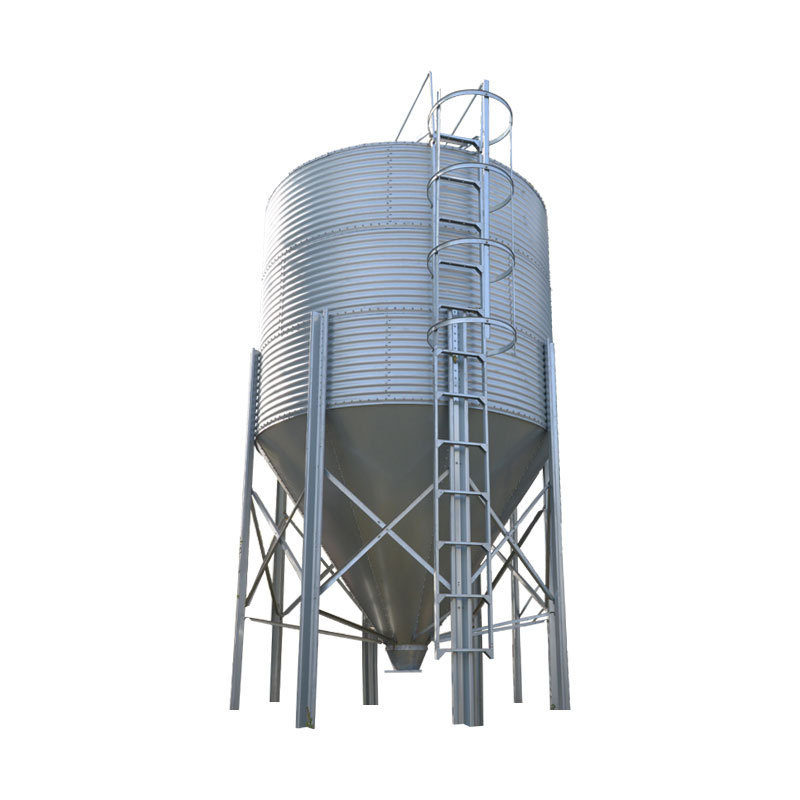
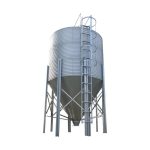
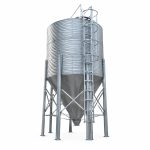
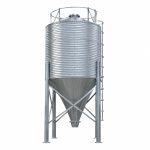
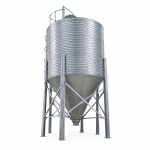
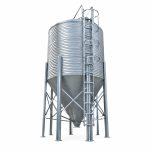
The poultry farming feed silo is an outdoor storage device used in large-scale poultry farms for centralized storage of dry mash or pelleted compound feed. It is usually installed outside the poultry house to store the feed needed for 1 to 5 days. Working together with automatic feeding lines, it enables full automation from feed storage to in-house distribution, making it an indispensable feed storage equipment for modern intensive poultry farms.
II. Capacity Range
The silo capacity supports multiple specifications customized from 3 tons to 30 tons, with common capacities including 3t, 5t, 8t, 10t, 15t, 20t, 25t, and 30t. Small farms can choose 3–5 tons, large-scale layer and broiler farms are recommended 8–15 tons, and large breeding bases can be equipped with 20–30 tons. Users can flexibly choose according to farm scale, daily feed consumption, and feeding cycle.
III. Materials and Craftsmanship
Galvanized Feed Silo: The body is made of 275g/㎡ double-sided hot-dip galvanized steel plate, enhanced with passivation treatment for rust resistance, with normal surface anti-corrosion capability of over 13 years. Screws are 8.8-grade M10 hot-dip galvanized bolts, passing a 48-hour salt spray test. Plate seams are sealed with sealing strips, providing wind and rain resistance and corrosion resistance.
FRP Feed Silo: Made by integrated spray-up and rolling process with special polyester resin and fiber, featuring good thermal insulation, light weight, high strength, moisture-proof and mildew-proof properties, and resistance to acid and alkali corrosion. The smooth inner wall ensures no residue during discharge.
IV. Structural Design
The silo has a cylindrical upper part and a conical lower part, which effectively reduces wind resistance and facilitates discharging. Its main components include the silo body, flip cover, ladder, and support columns.
Lid System: Controlled by an automatic tension torsion spring structure. The lid can be freely opened and closed by pulling a handle from the ground, making operation safe and convenient.
Observation Window: The lower cone is equipped with an organic transparent glass observation window, allowing users to visually check the remaining feed from the ground.
Ventilation Design: The upper cone is equipped with vent holes to balance internal and external air pressure and discharge hot and humid air.
Ladder and Guardrail: Anti-slip step design with circular safety guardrails for easy maintenance and inspection.
V. Core Advantages
Advantage Description Sealed and Moisture-proof Fully enclosed storage isolates rain, rodents, and insects, keeping feed fresh and free from deterioration Labor Reduction Eases labor shortage and high labor costs on farms, achieving quantitative feeding Disease Risk Reduction Reduces direct contact between people and feed, lowering the rate of pathogen transmission Convenient Observation Transparent observation window design allows feed levels to be checked from the ground
| Advantage | Description |
|---|---|
| Sealed and Moisture-proof | Fully enclosed storage isolates rain, rodents, and insects, keeping feed fresh and free from deterioration |
| Labor Reduction | Eases labor shortage and high labor costs on farms, achieving quantitative feeding |
| Disease Risk Reduction | Reduces direct contact between people and feed, lowering the rate of pathogen transmission |
| Convenient Observation | Transparent observation window design allows feed levels to be checked from the ground |
VI. Application Scenarios
The poultry farming feed silo is suitable for various large-scale poultry farming scenarios such as layer farms, broiler farms, and breeder farms. It can be combined with auger feeding lines, chain-disc feeding lines, and other automatic feeding systems to achieve timed and quantitative feed delivery into the house, and works with bulk feed trucks for unloading and replenishment.