
Stage Two: Slaughtering and Defeathering: Ensuring Product Cleanliness and Integrity Through Precision Processes
Following the initial preparation and stunning stage, poultry processing enters the critical phase of slaughtering and defeathering. The objective of this stage is to achieve a rapid and hygienic end-of-life process, followed by the complete and clean separation of the carcass from its feathers, laying the groundwork for further processing. This entire phase requires a strict balance of efficiency, hygiene, and product integrity, making it a core link that impacts the final appearance and shelf-life of the meat products. The stage comprises three technical steps: slaughtering and bleeding, scalding, and defeathering.
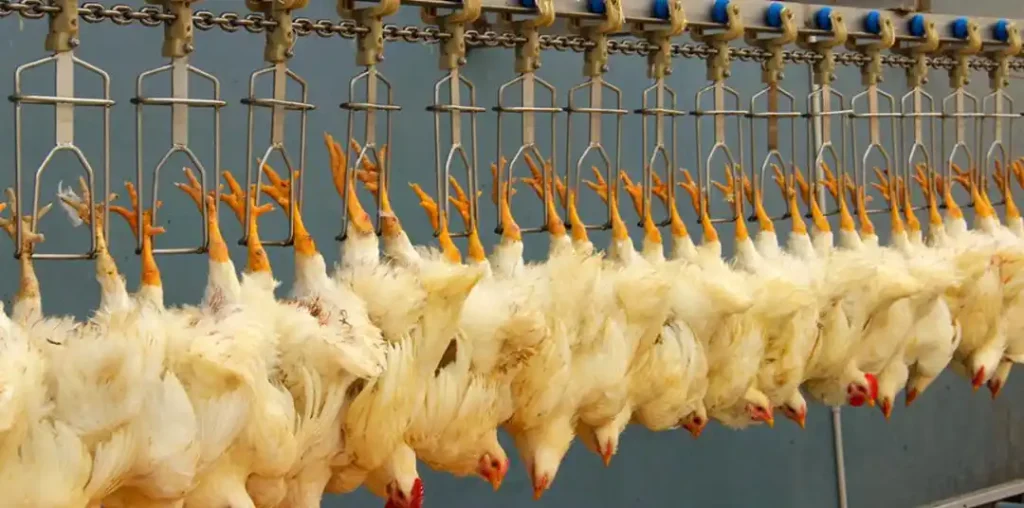
1. Slaughtering and Bleeding
The process begins immediately after stunning. While the birds are unconscious, they are transferred to the slaughter point. Typically, a rotating automatic neck cutter makes a precise cut, severing the carotid arteries and jugular veins in a single action. The carcass is then hung on a bleeding rail to allow for exsanguination.
The primary objective of this step is to achieve a swift and humane end to life and to facilitate complete bleeding. Thorough exsanguination is not only a fundamental requirement of slaughtering practice but also directly affects the sensory quality of the meat: the completeness of blood removal significantly impacts the color and flavor of the final product. Residual blood can darken the meat color and potentially introduce off-flavors, affecting shelf-life. Additionally, the collected poultry blood itself is a valuable by-product for the food industry, often used in producing blood curd, feed additives, and more.
The key control point is ensuring sufficient bleeding time, allowing gravity to naturally drain the vast majority of blood from the body. The specific duration varies depending on the poultry species and individual size. For instance, broilers typically require 2 to 3 minutes, whereas larger birds like ducks and geese need a longer period. Inadequate bleeding is a primary cause of carcass bruising, overall dull coloration, and can even increase the risk of microbial growth during subsequent processing.
2. Scalding
After sufficient bleeding, the carcasses proceed to the scalding process. Two common methods are used: immersion in a temperature-controlled hot water bath or passage through a steam tunnel with sprayers.
The purpose of this step is not to “cook” the bird but to apply controlled heat to relax the feather follicles, making the feathers easier to detach from the skin. The principle involves using moderate heat to soften the protein structures connecting the feathers to the skin.
The critical process control lies in the precise matching of temperature and time. These parameters vary significantly depending on the poultry species, breed, age, and even season:
- Broilers: With their thinner, more tender skin, they are typically scalded at 58-60°C for 60-120 seconds. The goal is to relax the follicles while maximizing skin integrity.
- Spent Layers, Ducks, Geese: These birds have coarser, more stubborn feathers anchored in stronger follicles and generally tougher skin. Consequently, they require higher temperatures (typically in the 60-64°C range) and/or longer processing times to effectively loosen the resilient feathers effectively.
Over-scalding is the primary quality risk at this stage. Excessive temperature or duration can severely damage or even cook the outer skin layer. This leads to discoloration and tearing, making the skin prone to being ripped off during subsequent defeathering, which severely compromises carcass appearance and grading. Such damage is irreversible.
3. Defeathering
After optimal scalding, the carcasses move to the defeathering stage. Modern production lines commonly use automated defeathering machines. Carcasses pass sequentially through a series of rotating drums or disks fitted with dense, flexible rubber “fingers.”
The purpose of defeathering is to efficiently and physically remove the loosened feathers through continuous, comprehensive friction between the rubber fingers and the carcass surface. The flexibility of the rubber fingers is designed to maximize feather removal while minimizing scratches or damage to the bird’s skin.
The key control point involves multi-stage, tandem processing. A standard production line typically employs 2 to 4 defeathering machines connected in series, forming a streamlined process:
- Primary Defeatherer: Primarily responsible for removing large feathers from areas like the wings and tail, as well as the main body feathers.
- Secondary/Finishing Defeatherers: Equipped with finer, more densely packed rubber fingers and potentially adjusted operating parameters (like speed), these machines focus on removing residual pinfeathers, new feather quills, and the most difficult-to-remove down.
Although automated defeathering is highly efficient, a manual finishing/picking station or inspection under high-intensity lamps usually follows the mechanical process. Quality control personnel here conduct meticulous inspections and use specialized tools (like tweezers) to manually remove any remaining fine hairs, quills, or foot cuticles missed by the machines. This ensures the carcass meets the cleanliness standards required for subsequent processing or market sale.
In summary, the slaughtering and defeathering stage represents a tightly linked, precision-driven operation. From precise slaughter and bleeding, to the species-specific accuracy of scalding, followed by multi-stage mechanical defeathering and final manual refinement, each link requires exact parameter control and meticulous quality management. This ensures not only the efficient production of clean carcasses but also maximizes the protection of the product’s skin integrity, external appearance, and intrinsic quality. It directly determines the commercial value of the primary product and is a vital, connecting link in the entire poultry processing chain, bridging the initial and subsequent stages.
