
Stage Four: Final Processing: Value Transformation from Uniform Carcass to Customized Product
At the conclusion of the poultry slaughter and processing line, the clean, chilled carcasses, having undergone a series of stringent hygiene and safety procedures, enter the final processing stage. This stage serves as the consolidation point and watershed of the production flow, with its core mission being to efficiently transform standardized carcasses into diverse final product forms based on market demands. This segment integrates physical handling, automated sorting, and path planning, directly determining the product’s final form, specification, value, and distribution channel. It primarily comprises three key steps: draining, grading, and subsequent directional processing.
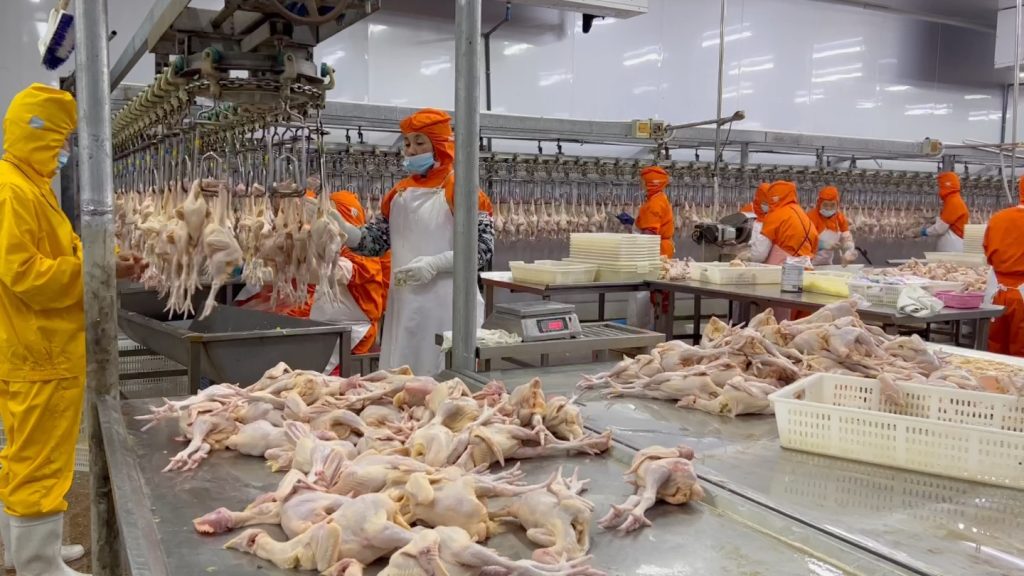
1. Draining: Ensuring Product Dryness and Quality Stability
Following the chilling process (especially water chilling), a significant amount of moisture adheres to the carcass surface. Draining is the essential step to remove this excess water, typically achieved through two main methods:
- Air-Chilling Tunnel/Air-Drying Tunnel: Carcasses are conveyed through a temperature-controlled channel (typically 2-4°C) where powerful, chilled air streams generated by high-efficiency fans continuously blow over their surfaces. This method not only evaporates moisture but also further evens out the carcass temperature and creates a dry skin surface. This is crucial for subsequent packaging appearance and preventing microbial growth in a damp environment.
- Shaker/Vibrating Drainer: Carcasses pass over a vibrating unit with specific amplitude and frequency. The physical shaking action effectively removes and collects free water from the surface and cavity for drainage.
Purpose: Firstly, to enhance product sensory quality—a dry carcass presents a better appearance after packaging and prevents liquid accumulation inside the bag. Secondly, to control microbial risk by reducing water activity. Thirdly, to ensure the accuracy of subsequent weighing and grading, preventing “water weight” from affecting measurement precision and cost accounting. Fourthly, to prevent ice crystal formation (for products destined for further freezing) and improve freezing efficiency.
2. Grading and Weighing: Data-Driven Automated Sorting
After draining, each carcass enters the Automated Weighing and Grading System. This is a highly automated information collection and distribution hub:
- High-Precision Weighing: Each carcass is weighed instantly and accurately as it passes through, with data recorded in real-time into the production management system.
- Automatic Grading: The system makes instant grading decisions based on preset weight ranges (e.g., <1.2kg, 1.2-1.5kg, 1.5-1.8kg, >1.8kg) or combined with optical inspection for criteria like shape/skin color.
- Intelligent Diversion: Based on the grading result, automated devices (such as diverters, switches) guide the carcass onto different conveyor lines, preparing it for different downstream processing paths.
Purpose: To achieve product standardization, meeting the precise specifications required by different customers and markets. This forms the basis for pricing and sales and is key to implementing lean manufacturing and optimizing downstream processing efficiency (e.g., cut-up line settings). Precise grading maximizes overall yield and product value.
3. Subsequent Processing Paths: Divergence into Customized Products
Based on order requirements and production planning, the graded carcasses proceed to one of three main processing paths:
- Path A: Whole Bird Packaging Line
- Process: Carcasses may first undergo shaping (for a more uniform and appealing appearance), then be placed into food-grade bags for vacuum packaging (air removal extends shelf life and prevents freezer burn), followed by outer packaging, labeling, and boxing.
- Products: Primarily produces whole frozen or chilled chickens/ducks, etc., destined directly for retail markets, food service, or further processing plants.
- Path B: Cut-up/Cutting Line
- Process: Carcasses are conveyed to the cutting room. This may involve highly automated robotic cut-up lines or semi-automated lines operated by skilled workers. Through precise cuts, the carcass is broken down into standardized portions such as breasts, legs (thighs and drumsticks), wings (drumettes, flats, tips), and frames.
- Subsequent Steps: The cut portions typically proceed immediately to sorting, trimming, and packaging, where they are individually packed according to specifications and order requirements. This is the core step in transforming a single carcass into multiple high-value-added products.
- Path C: Further Processing/Quick-Freezing Channel
- Process: For carcasses or portions intended for long-term storage or as raw materials for further processing, they are rapidly moved into a blast freezing tunnel or spiral freezer after packaging (or cutting). Under intense cold air streams of -30°C to -40°C, the product’s core temperature quickly passes through the zone of maximum ice crystal formation within hours, dropping to -18°C or below. They are then transferred to cold storage (-18°C or lower) for warehousing.
- Purpose: To maximally preserve the product’s cellular structure, nutrients, and flavor, ensuring safety and quality stability during extended storage. This is a key method for supplying international markets and balancing seasonal supply and demand.
Summary: The Final Integration of Efficiency, Flexibility, and Value
The final processing stage is where poultry processing shifts from being “production-oriented” to “market-oriented.” It ensures fundamental quality through drying, implements precise management and value differentiation via automated grading, and ultimately meets diverse market demands—from whole bird sales to portioned cuts, and from chilled distribution to frozen export—through multiple subsequent processing paths.
The operational efficiency, level of automation, and intelligent decision-making capabilities in this stage directly determine an enterprise’s order response speed, product added value, loss control, and ultimately, its market competitiveness. It transforms a standardized slaughter line into a flexible manufacturing system capable of producing a variety of end products, representing the final link in value realization for the modern poultry industry.
