
Stage Three: Evisceration and Washing: The Core Barrier for Food Safety
In modern poultry slaughtering processes, evisceration and washing represent the most critical technical stage for food safety control. This phase transitions from carcass handling to the internal cavity, with the core objectives of achieving efficient separation of viscera while establishing robust barriers for microbial control and temperature management. The ultimate goals are to ensure the edibility, safety, and shelf stability of the final product. This stage is strictly designated as a “sanitary processing area,” with the highest requirements for operational environment, equipment, and personnel hygiene. The main steps include transfer and evisceration, internal/external washing, and chilling.
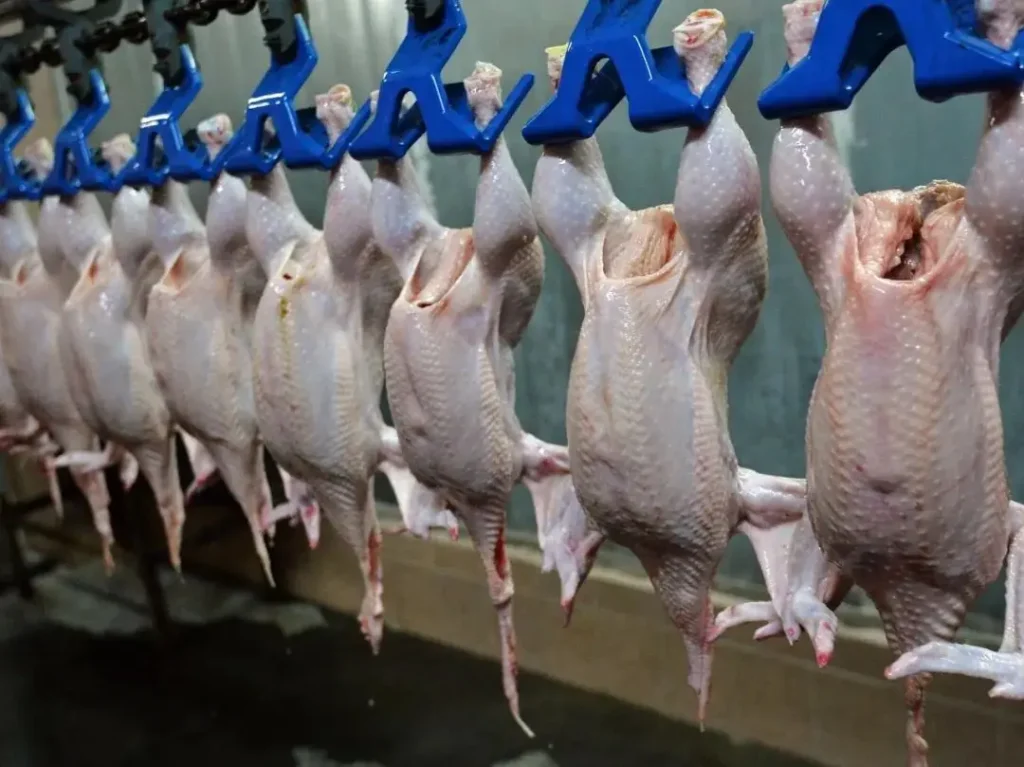
1. Transfer and Evisceration
This step marks the physical separation of the carcass from its internal organs and the initiation of the first systematic food safety screening.
- Transfer: After defeathering, carcasses are first transferred from the slaughter/defeathering conveyor line to a dedicated evisceration line. This process typically involves a change in hanging method—from “shackles” (holding the feet) to “hangers” (holding the neck or legs in a different orientation). This design positions the carcass in a head-down vertical orientation, greatly facilitating subsequent access to the body cavity and allowing any residual fluids, such as blood, to drain naturally during evisceration rather than pooling in the cavity.
- Evisceration: This is a highly automated and precise operation, conducted in two steps:
- Automatic Vent Opening: A machine positions the carcass and makes a precise circular or pre-determined cut around the vent area, creating a clean opening for removal of the viscera pack while minimizing accidental damage to the intestines.
- Automatic Evisceration: Programmable robotic arms then enter the body cavity. Specialized grippers at the end of the arms accurately grasp the main attachment points of the viscera pack (including the heart, liver, gizzard, and intestines) and withdraw it as a complete unit. This process demands high precision to minimize breakage of organs and the resulting risk of cross-contamination.
- Viscera Inspection (A Critical Control Point – CCP): The removed viscera pack is not immediately discarded. Instead, it travels on a synchronized conveyor line parallel to its corresponding carcass. This provides a crucial inspection window for official veterinarians or trained quality inspectors. The inspectors visually examine both the inside of the carcass cavity and the entire set of viscera for color, texture, shape, and any signs of disease, infection, parasites, or abnormalities (such as tumors, inflammation, or abscesses). Any carcass and its viscera deemed unacceptable are immediately marked and diverted from the main line for separate handling (e.g., condemnation or specific rendering), preventing problematic products from entering the food chain. This is a legally mandated core CCP for food safety.
Purpose: Firstly, to separate valuable edible offal by-products (heart, liver, gizzard, etc.) for individual processing. Secondly, and most importantly, the synchronized inspection enables the most effective screening for diseases and defects, serving as an irreplaceable step in safeguarding public health.
2. Internal and External Washing
Following evisceration, carcasses undergo a thorough washing procedure. Multiple sets of high-pressure water sprays (often using alternating cold/hot water or approved bactericidal solutions) thoroughly rinse both the internal cavity and external surface of the carcass from various angles.
Purpose: To physically remove any blood stains, feather fragments, visceral residue, and microbial contaminants that may have adhered to the carcass during slaughter, bleeding, and evisceration. Effective washing significantly reduces the initial microbial load on the carcass surface, forming the foundation for the success of subsequent chilling and preservation processes.
3. Chilling (A Critical Control Point – CCP)
After washing, carcasses must be rapidly cooled. This step is decisive for inhibiting pathogen growth, ensuring food safety, and extending shelf life, and is established as another CCP. The goal is to lower the deepest internal temperature of the carcass to a safe level of 4°C (or below) in the shortest time possible, thereby greatly suppressing the growth of common foodborne pathogens like Salmonellaand Campylobacter.
Two primary industrial chilling methods are used, each with distinct characteristics:
- Immersion Chilling (Water Chilling): Carcasses are submerged in a flowing ice-water mixture, either in batches or continuously. The ice water circulates rapidly around the carcasses, drawing out heat through conduction and convection.
- Advantages: Extremely high cooling efficiency, relatively lower equipment investment and energy costs, and helps maintain a plump appearance in the carcass.
- Disadvantages: Carcasses can absorb a certain amount of water (regulations in various countries set strict limits on weight gain from water absorption, e.g., a maximum of 2% in the EU). Moreover, all carcasses are chilled in the same water, posing a potential risk of microbial cross-contamination, necessitating strict monitoring of water quality and chlorine levels.
- Air Chilling: Carcasses are suspended in a refrigerated tunnel or room with low temperature and high-velocity air, undergoing dry cooling via forced convective cold air.
- Advantages: Eliminates the issue of water absorption (product yield is 100% of carcass weight). As there is no shared medium, the risk of cross-contamination is minimal, making it more hygienic. The drier surface is less conducive to bacterial growth, typically resulting in a longer shelf life and better skin color.
- Disadvantages: The cooling rate is generally slower than immersion chilling, and energy consumption and equipment investment costs are significantly higher. Due to its superior hygiene standards and product quality, this method is the predominant and often mandatory requirement in the EU market and is widely used for premium poultry products.
Purpose: Beyond simply lowering temperature, it involves strict time-temperature control to rapidly pass through the “temperature danger zone” (5-60°C) for microbial growth, providing the final safeguard for poultry meat safety and creating stable conditions for subsequent cutting, packaging, storage, and transportation.
Summary
The evisceration and washing stage serves as the technical nexus connecting primary processing with the production of high-value products. From the precise automated separation of viscera and synchronized inspection to the thorough physical washing and the decisive rapid chilling, every step is guided by the core logic of food safety: separation, cleaning, and inhibition. By implementing strict Standard Operating Procedures (SOPs) at this stage and focusing on monitoring the two CCPs—viscera inspection and chilling—the modern poultry processing industry controls the microbial and pathological risks of animal-derived food products at the very forefront of the production chain. This provides consumers with a safe, hygienic, and stable source of protein. The rigor applied in this phase directly reflects a company’s depth of compliance with food safety regulations and its commitment to responsibility towards the end consumer.
